
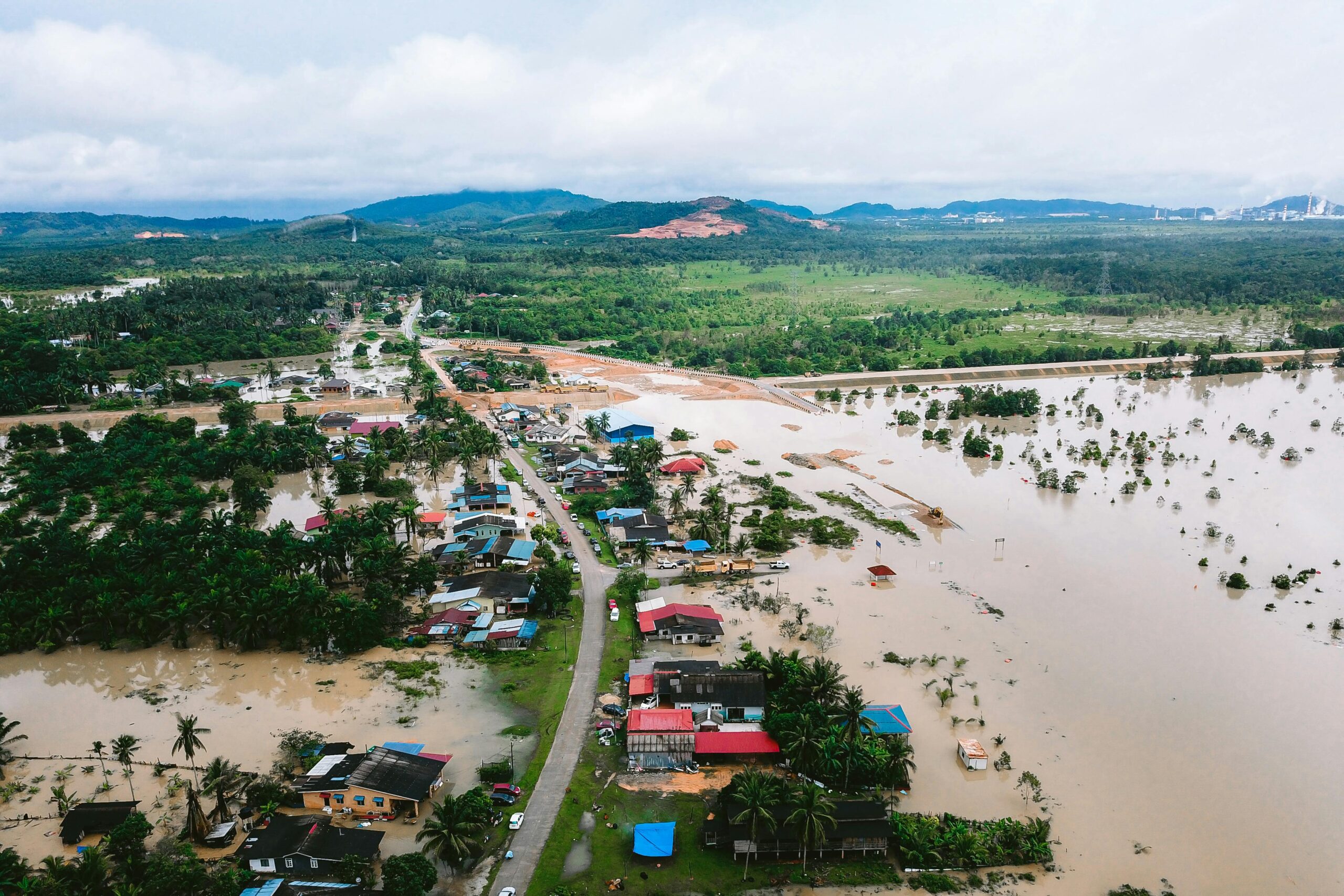
Climate change today is no longer a distant threat described in technical reports; it is a lived emergency tearing through communities. It respects no borders, no cultures, and spares no one. What once felt like a slow-burning crisis has accelerated into a cascade of devastation—a domino effect dismantling lives, economies, and ecosystems with frightening speed.
Global temperatures have already risen between 1.1 and 1.3 degrees Celsius since the Industrial Revolution, according to the Intergovernmental Panel on Climate Change (IPCC AR6, 2021). The year 2023 was the hottest ever recorded worldwide, with average warming reaching 1.19°C above pre-industrial levels (World Meteorological Organization, 2024). The IPCC warns that we are on course to breach 1.5°C by the early 2040s and approach 2°C by mid-century if current emission trends continue. That difference is not academic; every fraction of a degree adds force to the floods, droughts, and heatwaves that are already unfolding before us.
Pakistan offers a painful case study of this reality. In July 2025, unprecedented heatwaves of up to 48.5°C triggered accelerated glacier melt in Gilgit-Baltistan. Combined with heavy monsoon rains, this caused glacial lake outburst floods that destroyed villages and killed at least 72 people (The Guardian, July 9, 2025). Barely weeks later, the monsoon descended with terrifying intensity on Khyber Pakhtunkhwa. Swat, Bajaur, and Buner were among the hardest hit. In Buner alone, over 150 millimeters of rain fell in a single hour, sweeping away homes and killing more than 150 people in one day (The Guardian Weather Tracker, August 22, 2025). According to the Provincial Disaster Management Authority, more than 320 people across KP had died by mid-August, while nationwide monsoon fatalities exceeded 660 (Reuters, August 18, 2025). Survivors described the devastation as “doomsday,” with families too afraid to return to their villages (People Magazine, August 2025).
These are not random tragedies; they are the predictable outcomes of a warming climate. A rapid attribution study by World Weather Attribution found that climate change intensified Pakistan’s 2022 monsoon rains by about 50 to 75 percent, and has made today’s monsoon events 15–22 percent more extreme than they would have been without human-induced warming (WWA, 2022 & 2025). In other words, every additional tonne of carbon dioxide emitted globally adds water to the storms that drown Bannu’s crops, sweep away bridges in Swat, and bury families under landslides in Bajaur.
The costs are staggering. Pakistan lost more than $29 billion to climate-related disasters between 1992 and 2021, according to the UN Environment Programme. The 2022 floods alone affected 33 million people, displaced 8 million, killed over 1,700, and caused more than $40 billion in damages (Government of Pakistan & World Bank, 2023). Reconstruction costs were estimated at $16.3 billion, yet international pledges covered less than half that figure. The country now requires at least $152 billion in adaptation finance between 2023 and 2030 (World Bank & ADB, 2023), but climate funds trickle in at a pace that makes resilience a distant hope.
Meanwhile, global leaders continue to make promises that fall short of action. Greta Thunberg’s famous dismissal of “blah, blah, blah” still rings true, as summits conclude with lofty declarations but leave communities like those in Swat to pick up their dead and rebuild alone. The injustice is stark: Pakistan contributes less than 1 percent of global greenhouse gas emissions but sits among the ten most climate-vulnerable countries in the world (Germanwatch Global Climate Risk Index, 2021).
The crisis forces us to confront a moral and practical choice. We can continue with an economic model that treats the Earth as expendable, or we can radically reimagine our systems in favor of survival. Mitigation through cutting fossil fuels, adaptation through resilient infrastructure and water management, and justice through climate finance are not optional anymore—they are the only way forward. Delay only strengthens the storms and deepens the graves.
Climate change is no longer a looming shadow; it is the flood sweeping through Bajaur, the landslide in Swat, the glacial burst in Gilgit, and the unbearable heat in Jacobabad. It is here, rearranging lives and landscapes before our eyes. The question that remains is whether humanity can find the courage to rearrange its systems before the final domino falls.
The message could not be clearer: Pakistan is standing on the frontline of a crisis it did little to create, paying with lives, livelihoods, and futures. From the floods of Swat and Bajaur to the glacial bursts in Gilgit-Baltistan, each disaster is not just a natural tragedy but a policy failure. If those in power—both in Islamabad and in global capitals—continue to delay decisive action, the cost will be measured in graves rather than statistics. The cry from the mountains and the plains alike is simple: act now. Invest in resilience, enforce climate justice, and treat this as the existential emergency it is. Anything less is complicity in catastrophe.

Writer | Engineer | Political commentator |